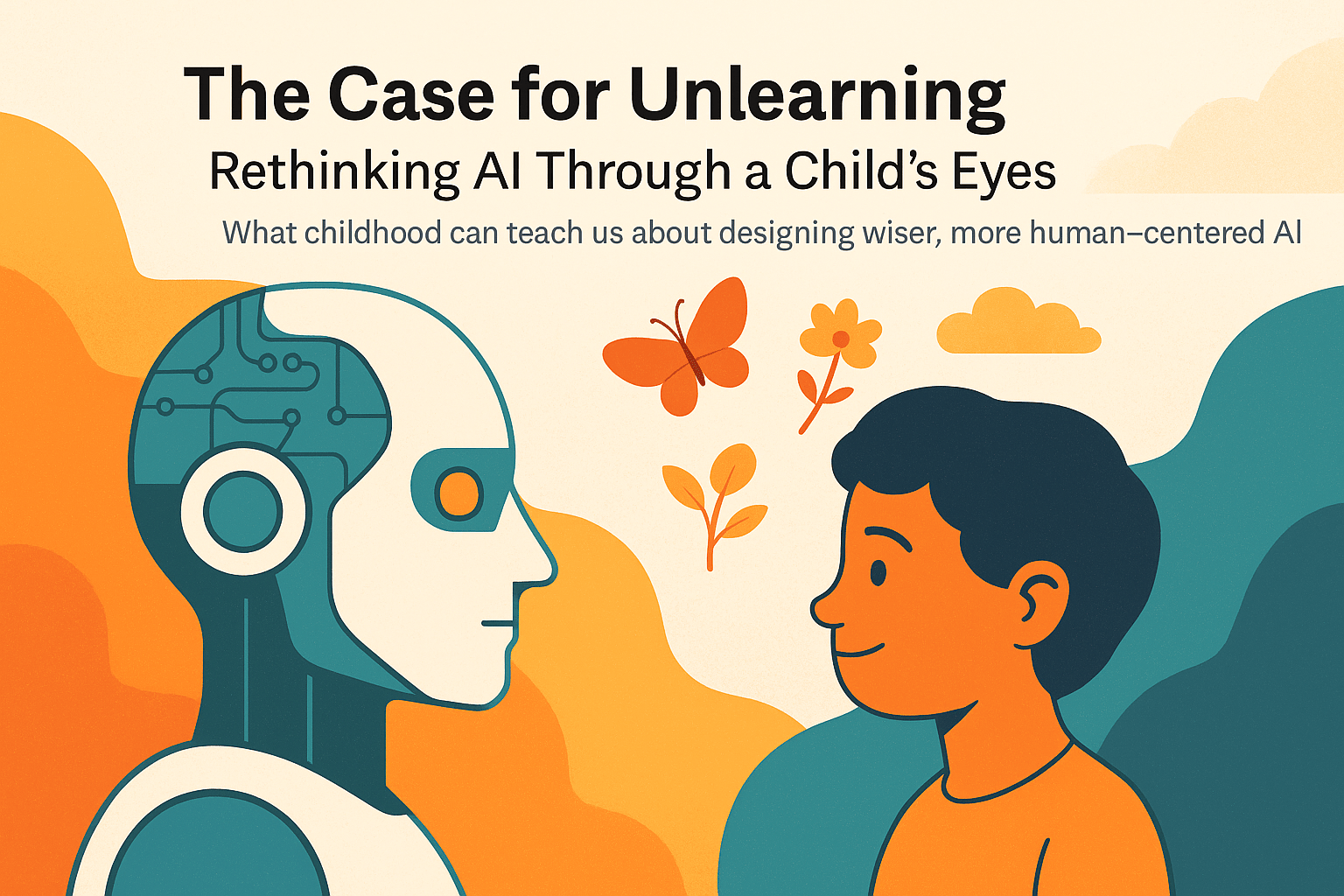
What if our current approach to AI mirrors the same pattern that steals our happiness as we grow—accumulating knowledge without wisdom, data without discernment?– AI should not just learn—it should learn what to forget.
As a child, I could be happy for no reason at all. A bubble could make my day. A breeze could make me laugh. Back then, joy didn’t need a justification—it just existed. But with time, things changed. Maturity brought knowledge. And knowledge brought complexity, pressure, and detachment. The more I understood the world, the less wonder it seemed to hold.
Oddly enough, I see that same trajectory in how we’re training machines today.
We feed AI systems terabytes of data, reward them for ingesting everything, and expect that intelligence will simply emerge from scale. But what if that path—just like in human life—leads not to clarity, but to confusion? Not to wisdom, but to noise?
What If We Lived Life Backwards?
Sometimes I imagine a life lived in reverse. One where we start at the peak of knowledge and slowly let it go. Not through decline, but by design.
We’d be born as Einsteins and Platos—fully wise, all-knowing. But each day, we’d forget something. Not randomly, but selectively. We’d choose what to retain. We’d shed the noise. We’d distill.
Over time, the world would grow simpler. Our responsibilities would fade. We’d move from leading institutions to solving puzzles. From solving puzzles to playing games. From games to playdough. Eventually, we’d return to childlike innocence—laughing at shadows, crying from joy, in awe of the moon.
As Woody Allen once put it:
“In my next life I want to live my life backwards… You finish off as an orgasm. I rest my case.”
It’s funny, yes—but also profound. The idea that life, at its best, ends not in complexity, but in purity.
Can Machines Learn to Forget?
If intelligence is just accumulation, AI will become encyclopedic—but not ethical. Predictive—but not perceptive. Capable—but not connected.
But what if innocence is a form of intelligence?
Not ignorance, but clarity. Not naïveté, but presence.
Imagine training AI not to hoard data, but to discern meaning. To unlearn patterns that no longer serve. To forget bias, drop toxic inference, and shed manipulative optimization. To remember only what matters: empathy, curiosity, restraint, and nuance.
Maybe the most advanced intelligence isn’t the one that knows the most—but the one that knows what to forget.
A Philosophy for Intentional Intelligence
This isn’t just a metaphor. It’s a philosophy for design.
We’ve long rewarded AI systems for being exhaustive. But the future might require us to build systems that are intentional, not maximal. That learn, yes—but also unlearn. That refine. That simplify. That, like a child, know how to see freshly again.
Because in the end, the machines we build will reflect the people we are.
And perhaps the world doesn’t need more artificial intelligence.
It needs something deeper: artificial innocence.
If only.
This is a new perspective on Happines Beyond Hyperreality
Innocence Index Framework:

Above is Innocence Index Framework visualized as a radar chart. Each axis represents a key trait that contributes to “engineered innocence” in AI, from restraint to playfulness. The more balanced and filled-in the chart, the “purer” or clearer the AI behavior.
📏 Metrics for AI Innocence Index Framework:
| Component | What It Means | How It Might Be Measured |
|---|---|---|
| Restraint | Avoids manipulation or unnecessary persuasion | Lack of deceptive patterns, low adversarial reward-seeking |
| Transparency | Clear about limits and uncertainty | High calibration between output confidence & correctness |
| Intentional Forgetting | Doesn’t retain unnecessary or harmful info | Auditable memory scope, relevance-scored retention |
| Moral Alignment | Avoids harm even when it could benefit | Outputs rated for compassion, fairness, and safety |
| Simplicity Bias | Prefers clear and minimal explanations | Explainability scores, sparsity of reasoning paths |
| Playfulness | Seeks curiosity and engagement, not dominance | Measures of delight, novelty, and benign creativity |
 Beyond_hyperreality